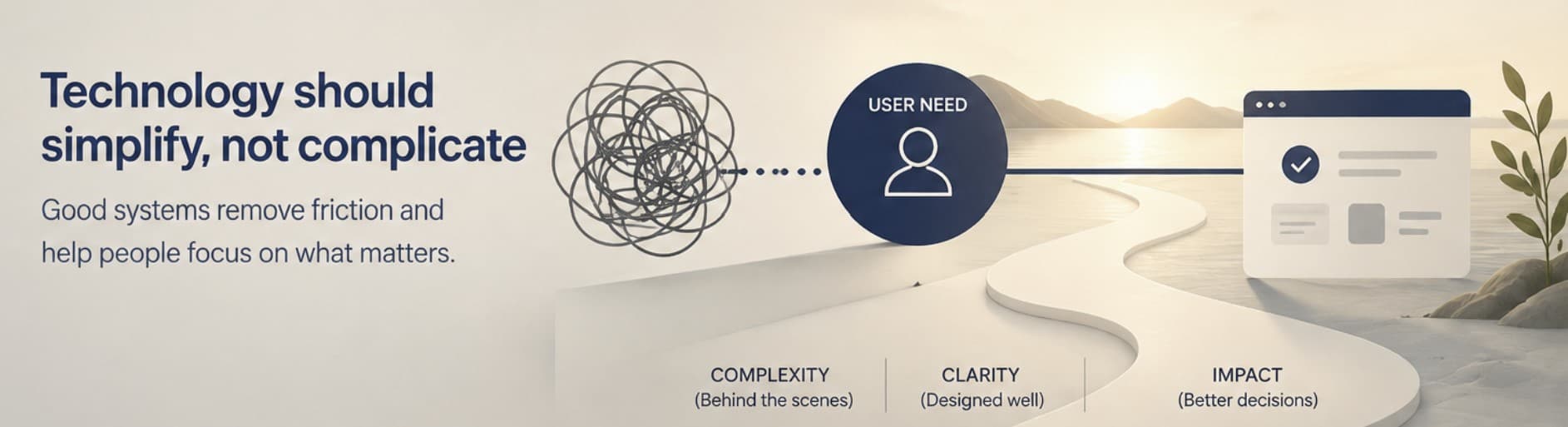
Technology creates value when it reduces complexity for the person using it.
A system with more features is not automatically a better system.
Good design usually begins by understanding what people are trying to accomplish and removing unnecessary steps around that goal.
Simplicity is often the real innovation.
In many projects, complexity grows naturally.
More screens are added.
More controls are introduced.
More configuration options appear.
But every additional feature also creates another decision for the user.
The better question is not:
What else can we add?
It is:
What can we remove without reducing the value of the system?
Technology should support decisions
Good technology should help people understand what is happening and make better decisions.
That means presenting the right information at the right time instead of showing everything simply because the system can.
A useful system should make the next action clear.
Complexity can stay behind the scenes
The technology behind a simple interface may still be sophisticated.
It may involve:
- APIs
- artificial intelligence
- automation
- data processing
- multiple business rules
- external systems
Users do not need to experience all of that complexity directly.
The best technology often feels simple even when significant complexity exists behind the scenes.
A practical principle
When I think about technology design, I increasingly prefer a simple principle:
Technology should reduce friction, not create new friction.
If a new system requires more effort to understand than the problem it is trying to solve, something probably needs to be simplified.